
FTC Staff Perspectives on Small Business Financing Enforcement Dangers
The staff of the Federal Trade Commission's (FTC) Bureau of Consumer Protection released a much-anticipated paper on small business financing that highlights enforcement dangers on February 26, 2020. The staff are sounding the alarm on FTC enforcement and its investigations of small business financing providers and their marketers, servicers, and collectors.
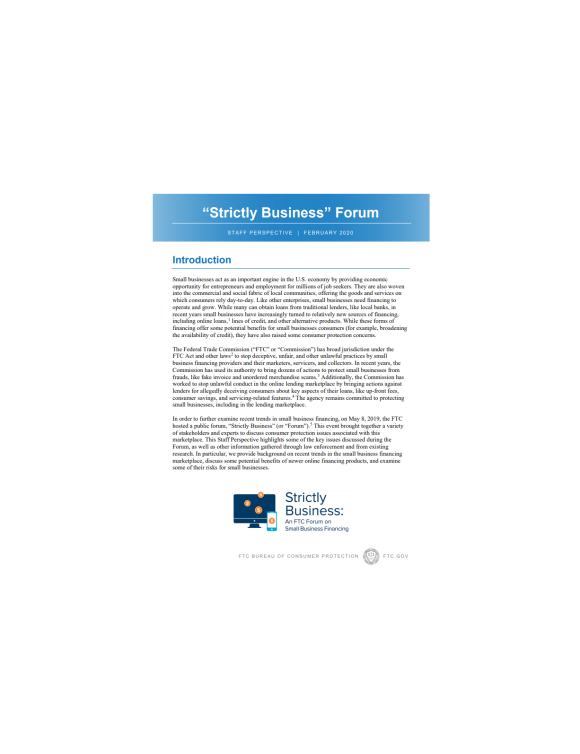
The big picture: The 12-page report provides staff perspectives on key issues discussed at the FTC's May 2019 forum on small business financing, "Strictly Business," including online loans and alternative financing products (Forum). The report includes several staff cautions to small business finance providers and their service providers to help them avoid the types of conduct the FTC has alleged to be unlawful. The report emphasizes that the FTC has broad jurisdiction over commercial financing under the FTC Act and other laws that prohibit deceptive, unfair, and unlawful practices by small business financing providers and their marketers, servicers, and collectors. Perhaps to underscore this point, the staff repeatedly refer to small business borrowers as "consumers" throughout the report, suggesting that they see no difference in the FTC's authority over consumer protection and small business protection.
Small business financing marketplace: The paper describes the small business financing marketplace, including such topics as:
- Online lenders that offer loan or credit agreements that resemble traditional bank loans or lines of credit—accruing interest and requiring monthly payments over a set term length.
- Finance providers that offer products with different features. For example, in lieu of interest, products that involve flat fees (and thus offer no savings for borrowers who repay early) or that require weekly or daily repayments.
- Higher-cost products allegedly offered to higher-risk businesses or owners with low credit scores, including "merchant cash advances" (MCAs), which received particular attention from the FTC. MCAs are styled as purchases of a business's future receivables, which are often repaid daily based on a fixed percentage of daily sales.
Potential benefits of online lending: The paper describes potential benefits of online financing: speed and convenience, broadening access to credit, financing amounts, terms, and repayment options.
Consumer protection concerns: The paper highlights several features of small business financing products that can raise "consumer" protection concerns: (1) inconsistent information provided to business owners; (2) concerns that finance providers use widely differing methods for calculating and describing the key features of their products—impeding small business owners' ability to make apples-to-apples comparisons; and (3) small business owner confusion about features. Notably, while the Truth-in-Lending Act requires the disclosure of annual percentage rate (APR) and other key pieces of information in personal credit transactions, it generally does not apply to small business financing.
- Staff caution: Staff highlight that small business finance providers should avoid the sorts of practices that the FTC has alleged to be deceptive in prior enforcement actions involving either small businesses or individual consumers, including actions involving personal loans in which it charged lenders with making misleading claims regarding fees, consumer savings, payment amounts, and interest rates. "Given the possibility of consumer confusion in the small business financing marketplace, providers should keep in mind that the FTC Act's prohibition against misleading claims applies to these products."
Focus on MCAs: The Forum highlighted that MCA providers generally offer high-cost, short-term cash advances to small businesses to purchase a fixed amount of their future receivables. In exchange, the business must repay the advanced amount plus a "factor"—often between 20% and 50% of that amount. The MCA provider generally collects a fixed percentage or amount (estimating the percentage) of the business's daily revenue. Thus the small business's daily payments are supposed to rise or fall to reflect its daily sales. According to the report, the business makes these payments until the MCA is repaid, or, alternatively, the business simply fails, in which case the repayment obligation is extinguished. Additionally, although MCAs do not technically include a set term length, they are typically repaid within a few months to one year.
- MCA concerns and cautions: Forum participants and others have expressed concerns about MCAs, including: (1) high costs; (2) aggressive, and potentially misleading, marketing practices, including lead generation; (3) failure to provide reconciliations and "true-ups" to lower daily payment amounts, which the report suggests would be potentially unlawful, if MCA providers fail to adjust payment amounts to reflect a decrease in sales; and (4) potentially abusive collection practices.
- "Staff would caution small business finance providers and their collectors to avoid the types of conduct we have alleged to be unlawful—such as collecting amounts consumers do not owe, making egregious false threats of arrest or other severe consequences, disclosing private debt information to third parties (such as family members), or harassing consumers with continuous calls or abusive language."
- Staff caution on marketing and lead generation: In response to concerns related to MCA marketing, staff caution that ISOs, brokers, and lead generators that market MCAs and other financing products should avoid potentially false or unsubstantiated advertising claims. Also, staff say that finance providers should be aware that their use of these marketing intermediaries does not immunize them from liability under the FTC Act.
- "To comply with the law, providers should take steps to ensure that their marketers do not engage in deception or other unlawful conduct by carefully vetting and monitoring their lead sources for warning signs (like consumer complaints), auditing marketers, and requiring and enforcing contractual compliance standards with these entities."
Between the lines: Given the attention small business financing products are receiving, it would not be surprising if the FTC has open investigations involving small business financing products. FTC staff will frequently release reports highlighting observations from the marketplace and describing conduct that can become the basis for enforcement actions.
* * * * * *
Related Articles and Presentations
FTC to Host Small Business Financing Forum
Navigating CFPB, FTC, and State Attorneys General Consumer Protection Investigations
Marketplace Lending Under the FTC Microscope
FinTech and Marketplace Lenders Under Scrutiny
Five "Lessons" for Lead Generation Advertisers
The CFPB's Field Hearing on Small Business Lending
California DBO Proposed Regulations Implementing Commercial Financing Disclosures
* * * * * *
For more information, please contact Jonathan L. Pompan at 202.344.4383, or at jlpompan@venable.com.
Jonathan L. Pompan, a partner in the Washington, DC office of Venable LLP, co-chairs the firm's Consumer Financial Services Practice Group. His practice focuses on providing comprehensive legal advice and regulatory advocacy to a broad spectrum of clients, such as nonbank financial products and services providers, nonprofit organizations, and trade and professional associations, before the CFPB, the FTC, state attorneys general, and regulatory agencies.
This article is not intended to provide legal advice or opinion and should not be relied on as such. Legal advice can only be provided in response to specific fact situations.